Posted on

San Diego Wedding Season: Booking Your Mobile Makeup Artist Early

San Diego Wedding Season

Planning a San Diego wedding involves more than choosing a venue and setting a date. Hair and makeup also need a place in the early planning. The getting-ready location, bridal party size and first photo time all affect the morning schedule.

San Diego’s busy wedding periods make early inquiries especially helpful. Popular dates attract couples planning coastal ceremonies, garden weddings and hotel celebrations. Booking hair and makeup early gives you more time to coordinate the details.

Brittany Brown Beauty provides mobile bridal hair and makeup across Orange County and San Diego. Brittany travels to the getting-ready location and brings suitable lighting for makeup application. The venue, preparation space and wedding schedule all help shape the plan.

Why San Diego’s Peak Season Books Up Fast

Certain dates attract more wedding bookings than others. Coastal weather, guest travel and venue availability all influence these choices.

Coastal Weather and Popular Wedding Dates

San Diego’s coastal climate attracts couples to beaches, bluffs and gardens. However, coastal conditions can change throughout the day. UC San Diego describes a marine stratus layer often called May Gray or June Gloom. It usually occurs from May through June and affects coastal areas. Cloud cover often clears into hazy afternoon sunshine, although conditions vary each year.

Weekends and long weekends also attract couples with traveling guests. These dates make it easier for people coming from other cities to attend. As a result, many couples compete for the same weekends.

Venue Availability and Setting

Each venue can host only a limited number of weddings each weekend. Popular dates can fill quickly, affecting the availability of other wedding vendors. The venue setting also affects the preparation plan.

These San Diego venues offer examples of different wedding settings:

  • Hotel del Coronado: The hotel lists wedding spaces on private sections of Coronado Beach. It also offers a bridal dressing room. Beach weddings bring sea air, wind and strong light into the preparation plan.
  • Scripps Seaside Forum: This oceanfront venue sits steps from La Jolla Shores. Its facilities include a garden plaza. Marine air and changing light can affect hair, makeup and wedding photos.
  • Rancho Valencia in Rancho Santa Fe: The resort offers lawns, a rose garden and a courtyard for ceremonies. These garden settings bring shade, dappled light and changing outdoor conditions.

The preparation plan should also account for the type of venue:

  • Coastal: Wind, sea air and strong sunlight can affect makeup finish and hairstyle hold.
  • Inland: Temperature and available shade are worth checking.
  • Hotel: Shared rooms and suites require coordination around access and preparation times.
  • Private estate or rental: Available space, lighting and access depend on the property. Photos of the preparation area can help the artist plan.
  • Garden: Shade and dappled sunlight can change how makeup looks outdoors. Check the makeup in lighting similar to the ceremony setting.

Each property has its own spaces, rules and schedule. The preparation plan should reflect the actual venue and getting-ready location.

Coordinating With Other Wedding Vendors

Photographers, planners, florists and hair and makeup artists may need the same room. Their schedules can overlap during the morning. A clear preparation schedule helps everyone work around the available space. Hair and makeup timing also affects when photos and other tasks can begin.

Understanding the Booking Timeline

Check hair and makeup availability while the venue and schedule are still taking shape. Confirming the venue date does not secure an artist. Party size, travel and preparation location also affect availability.

Consider a late-afternoon ceremony at a coastal venue. The bridal party may be getting ready at a hotel across town. The schedule needs time for hair, makeup, preparation photos and travel. Each part depends on knowing who is available and when.

When San Diego’s Wedding Season Peaks

San Diego weddings take place throughout the year. Brittany Brown Beauty’s local guidance identifies March through June and September through November as busier periods. These are general patterns, not fixed booking seasons.

Weather also varies by location and date. A coastal ceremony in May may begin under cloud cover. A location just a few miles inland may have brighter skies. Conditions also change from year to year. Avoid basing an outdoor plan on one expected forecast. Ask your stylist how the hairstyle and makeup can suit changing conditions.

How Far in Advance to Secure Your Date

Brittany recommends booking a mobile artist six to twelve months ahead. This is especially helpful during San Diego’s busier wedding periods. Treat this timeframe as general guidance, not a deadline. Availability depends on the date and other booking details.

Earlier inquiries can help in several situations:

  • Popular weekends and holiday dates: More couples may want the same wedding dates.
  • Large bridal parties: More people need preparation time. The schedule also has less room for delays.
  • Well-known venues: Popular venues may book early. Vendors working those dates may also receive more inquiries.
  • A separate getting-ready location: The schedule needs to include travel between the preparation space and ceremony venue.
  • Travel between Orange County and San Diego: Longer journeys require additional planning. Discuss the locations early.

Contact the artist once your date and location are confirmed. You do not need a complete wedding schedule before making an inquiry. The article on how far in advance to book hair and makeup in Orange County offers more booking advice.

What Happens If You Book Late

Waiting too long can limit your choices. Your preferred artist may already have another booking. Larger bridal parties can also be harder to accommodate. Travel, preparation time and ceremony schedules need to fit together. A shorter planning window leaves less room for changes.

However, a late inquiry does not always mean no artist is available. Some dates may still be open. Smaller parties may also fit more easily into an artist’s schedule. Ask about your date before ruling out your preferred artist. Brides traveling from elsewhere can read about booking a bridal trial as an out-of-town bride.

Why Mobile Artists Are in Especially High Demand This Season

San Diego weddings often involve several locations throughout the day. The bridal party may get ready at a hotel or private rental before traveling to the venue. A mobile artist can provide hair and makeup at the preparation location.

  • Getting ready where the bridal party stays: Brittany travels to hotels, venue suites, private homes and rental properties. The bridal party can prepare at its chosen location.
  • No salon trip before the ceremony: The group can stay together instead of making another journey before photos and the ceremony.
  • Suitable lighting for makeup: Brittany brings lighting for makeup application. This reduces reliance on the room’s existing lights. Some hotel rooms and venue suites have limited or uneven lighting. A single window or overhead fixture can create unwanted shadows. Other rooms may already have suitable lighting. Bringing additional lighting gives the artist another option. The article on how wedding lighting affects bridal makeup explains the difference.
  • A schedule built around the wedding day: Arrival, preparation, styling and finishing times can account for photos and the ceremony.
  • Planning for coastal conditions: Humidity, sea air and wind can affect makeup and hairstyle hold. The article on bridal makeup for windy coastal ceremonies offers related advice.
  • A suitable preparation location: The schedule should account for travel time, access and parking. These details matter when the preparation space differs from the ceremony venue.

Mobile service removes the need for a separate salon visit. However, travel times, room conditions and weather can still affect the schedule. Leave enough time for these details when planning the morning.

You can view examples of Brittany’s work in the Bridal Hair and Makeup Portfolio. Brittany has worked in the makeup industry for more than 11 years. Her About Brittany page shares more about her background.

Planning a San Diego Wedding?

Share your wedding date, venue, getting-ready location and approximate bridal party size with Brittany. These details help her discuss the arrangements and check availability. Brittany provides mobile bridal hair and makeup across San Diego, Orange County and surrounding areas. Click the button below to schedule a consultation online.

Frequently Asked Questions

1. What makes San Diego wedding season different from other Orange County venues?

Neither area is one uniform market. Both offer beaches, gardens, hotels and estates, so the differences come from specific venues more than county lines. San Diego examples include beach ceremonies on Coronado and oceanfront spaces in La Jolla. Orange County wedding venues include resorts such as Pelican Hill. They also include garden settings such as Sherman Library and Gardens in Corona del Mar. Travel and preparation logistics differ by venue. Read about bridal makeup at the Resort at Pelican Hill for an Orange County example.

2. How far in advance should I book for San Diego wedding season?

Brittany’s guidance is 6 to 12 months ahead for busier periods. Think of it as guidance, not a cutoff. Popular dates, large parties and well-known venues call for earlier inquiries. Dates fill at different rates, so ask about yours.

3. Does the venue affect my makeup or hair plan?

Yes. Lighting in the getting-ready space, the room itself, coastal exposure, ceremony timing and travel between locations all shape the plan. A beachfront ceremony may call for different hold and finish choices than an indoor ballroom. Read how your wedding venue influences your bridal hairstyle for hair examples.

4. Can a mobile makeup artist get ready with the bridal party at a hotel or private home?

Yes. Mobile service means the artist comes to you. That might be a hotel room, a venue suite, a home or a rental. Access, space and parking vary by location, so confirm them with the hotel or host. Share the location in your inquiry so the arrangements can be discussed.

5. Should I book my bridal makeup artist before finalizing the wedding-day timeline?

Yes. Availability depends on your date and location, not on a final timeline. Early contact lets the schedule form around the artist’s calendar, the party size and the ceremony start. The plan can adjust as details settle. The wedding day beauty timeline shows how the morning typically fits together.

Posted on

On-Set Etiquette for Makeup Artists Working With Creative Directors

on-set etiquette for makeup artists working with creative

On-set etiquette for makeup artists working with creative directors shapes how smoothly a shoot runs from the first call time to the final frame. Photographers, brands, and production clients hire a makeup artist for skin that photographs well. They also expect someone who fits into a fast-moving set without adding friction.

At Brittany Brown Beauty, commercial and editorial makeup follows a clear set of habits that protect the schedule, the look, and the working relationship.

This guide explains those habits for anyone booking an artist for lifestyle campaigns, editorial shoots, or commercial productions in Orange County and San Diego.

Why On-Set Etiquette Affects the Whole Production

A makeup artist touches nearly every part of a shoot. Talent sits in the chair before the first frame. The same talent returns between setups for touch-ups. The artist also stands close to the camera, the lighting, and the creative director’s monitor for most of the day.

Because of that position, small communication habits carry real weight. A touch-up at the wrong moment can break a take. A look that drifts from the approved reference can mean redoing setups. Clear, calm communication keeps the crew focused and gives the creative director confidence that the look will stay consistent from the first setup to the last.

Experience also matters here. Brittany has worked in the makeup industry for more than 11 years, including print and production work. That time on set teaches an artist when to speak up, when to wait, and how to stay useful without becoming a distraction. You can see the range of this work in the portfolio.

Best Practices

The habits below separate a smooth on-set experience from a stressful one. Each one comes down to preparation, clear communication, and respect for the people leading the shoot.

Reviewing the Shot List Before Applying Makeup

Good on-set work starts before the artist opens a kit. Reviewing the shot list and the lighting plan with the creative director shows which setups come first, which angles land closest to the lens, and where the talent will stand in relation to the light.

That review shapes real product decisions. Studio strobes, natural daylight, and mixed light all treat skin differently, so each calls for its own approach. Brittany’s commercial work focuses on five technical points:

  • Light absorption: Neutralizing shine and redness so high-resolution stills look clean and retouching stays simple.
  • Light management: Keeping digital sensors from over-highlighting oily areas, which protects the final images.
  • Pigment control: Keeping colors accurate across the different light temperatures of studio and outdoor settings.
  • Texture smoothing: Creating a finish that stays invisible even in extreme close-up 4K video.
  • Sustained durability: Layering formulas so the makeup holds up through long outdoor sessions.

Asking questions at this stage saves time later. Is the look clean and natural or more graphic? Will the shoot move between indoor and outdoor locations? Are there close-up or video deliverables? The answers guide every step that follows.

Communicating Touch-Ups Without Disrupting Flow

Touch-ups matter on a long shoot, but timing matters just as much. An artist who rushes in during a take interrupts the photographer and the talent. An artist who stays out of reach lets shine and fading build up unnoticed.

The best approach is to stay near the set, watch the playback, and step in during natural pauses. Monitoring playback lets the artist check how the makeup reads on camera instead of guessing from across the room. Brittany provides continuous touch-ups through the day and uses the monitor to confirm that the skin still looks accurate on screen.

Short, quiet signals help too. A brief glance or a one-line check-in with the photographer or first assistant tells everyone that a touch-up is coming. The set keeps its rhythm, and the talent stays comfortable.

Respecting the Creative Director’s Vision

The creative director owns the look. The makeup artist brings technical skill, and the creative director sets the direction. Respecting that division is the most important rule of on-set etiquette.

In practice, that means following the approved references, raising concerns privately instead of in front of the crew, and offering alternatives only when a technical issue affects the image. If the lighting makes a chosen shade read differently on camera, a good artist explains the problem briefly and proposes a fix. The creative director then makes the final call.

This approach reflects Brittany’s broader belief that makeup is an art form and a way to express individual style. On a commercial set, that creative range serves the client’s vision first.

What Sets an Experienced On-Set Artist Apart

Experienced artists make a set feel easier. Several qualities show up again and again:

  • A complete professional station: Brittany arrives with lighting and seating, so the work does not depend on whatever the location offers.
  • Coordination with the creative team: She reviews lighting plans and shot lists with creative directors before the first application.
  • Technical range: Her work covers print, production, and editorial looks, along with corrective and mature-skin makeup. Each requires a different eye for skin and light.
  • Efficient wrap: At the end of the day, she handles talent cleanup and kit teardown quickly so the crew can move on.
  • A public track record: Brittany has been featured in Voyage LA Magazine and SDVoyager.

Clients also describe the experience in their own words. One reviewer, who hired Brittany for shoots and special events, called her a pro who has created many of her favorite hair and makeup looks. Another client, a bride, said Brittany works extremely well with other vendors, a quality that matters on any set where several teams work side by side.

If your next campaign, editorial shoot, or production needs a makeup artist who understands set flow, Contact Brittany Brown to discuss your project. You can learn more about her training and background on the About page.

Frequently Asked Questions

1. How does on-set etiquette for makeup artists differ from bridal makeup application?

Bridal makeup centers on the client’s feelings and a look that feels like herself, but elevated. Commercial and editorial work centers on the camera, the lighting plan, and the creative director’s vision. The artist also works around other crew members, shares space with the photographer, and touches up in short windows between setups. The emphasis shifts toward light absorption, pigment control, and texture smoothing, because the final judge is the lens and the creative director’s approved look.

2. What should a brand or photographer expect when booking a makeup artist for a commercial shoot?

Expect a review of the shot list and lighting plan before makeup begins. Brittany brings a complete professional station with lighting and seating. She stays close to set, monitors playback, and handles continuous touch-ups without interrupting the flow of the shoot. At wrap, she handles talent cleanup and kit teardown efficiently.

3. How is makeup adjusted for lighting on a commercial set?

The artist chooses products and finishes based on the lighting plan. Studio strobes, natural light, and mixed light all affect how skin and color appear on camera. Brittany manages light absorption to control shine and redness, uses pigment control to keep colors accurate across different light temperatures, and layers formulas for sustained durability during long outdoor sessions. She also uses playback to confirm how the skin reads on screen and adjusts as needed.

4. How should makeup artists prepare for 4K video and close-up content?

Makeup artists should focus on texture smoothing and a finish that stays invisible in extreme close-ups. They should also consider how skin appears under the lighting used for the production and check playback to confirm that the makeup reads well on screen. 

5. How can makeup artists match makeup to a brand’s identity in commercial projects?

Makeup artists should review the approved references and understand the creative director’s vision before applying makeup. The look should support the brand’s intended style while accounting for the lighting plan, camera angles, and type of content being produced. Any technical concerns should be communicated clearly so the creative director can make the final decision. 

Posted on

Waterproof Bridal Makeup for Beach and Outdoor Ceremonies

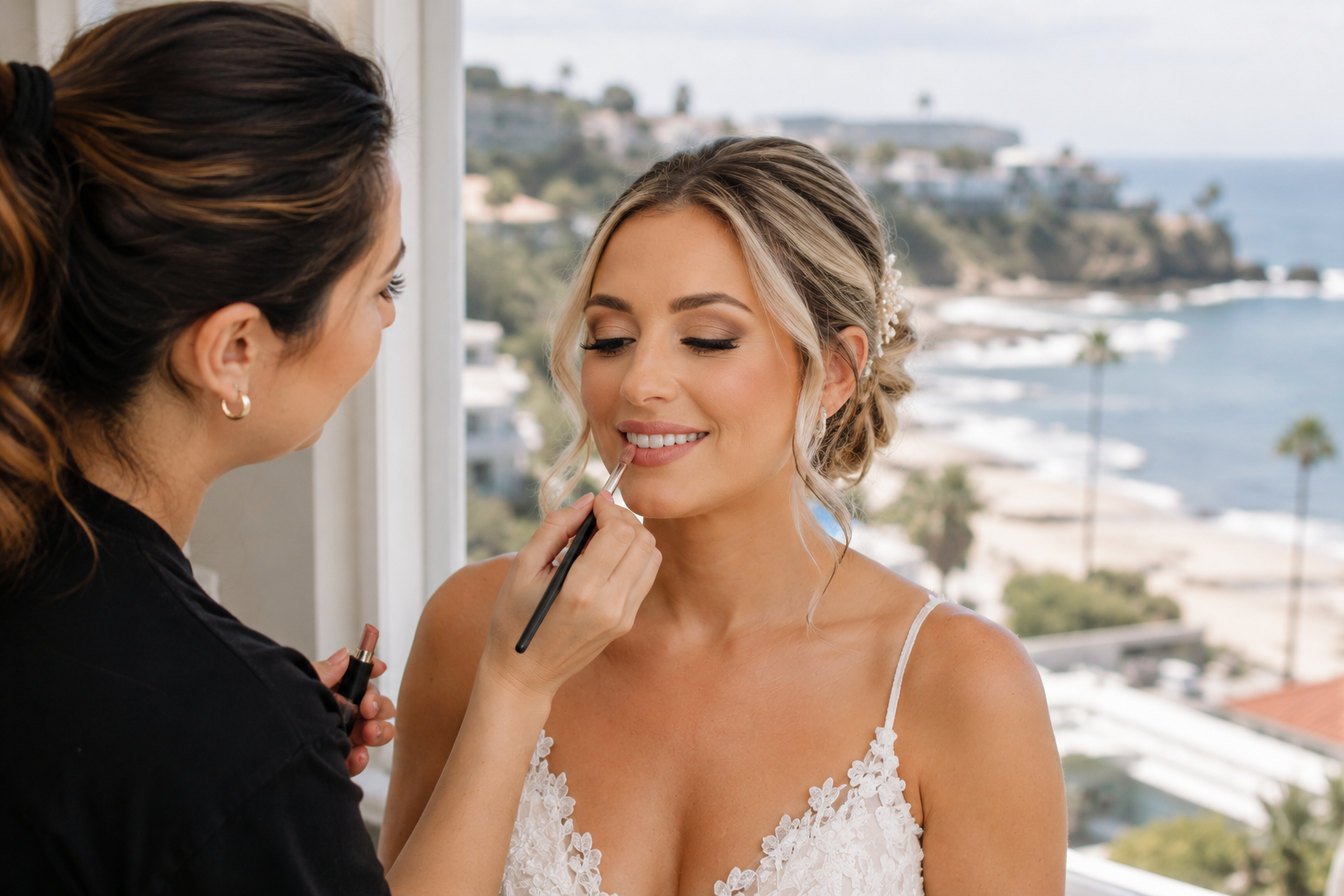
Bride receiving professional bridal makeup in Laguna Beach, California

Beach and outdoor ceremonies are some of the most beautiful weddings I get to work on, and they also come with a very real question every bride should ask early: will my makeup actually hold up out here? Between happy tears, sea air, sun, and the occasional coastal breeze, an outdoor Orange County or San Diego ceremony asks a lot more of your makeup than an indoor venue does. After 11+ years of hands-on bridal work along this coastline, building a look that holds up outdoors is something I plan for from the very first consultation.

Quick answer: a truly reliable waterproof bridal look comes down to three things, a waterproof base and concealer, smudge-proof eye makeup, and a long-wear lip formula, all applied with proper skin prep and setting technique. No formula is completely foolproof for every skin type or every condition, which is exactly why a trial run matters. Here’s how I approach it, checklist-style, so you know what to ask about and expect.

Why Waterproof Formulas Matter for Outdoor Ceremonies

Outdoor ceremonies expose your makeup to conditions an indoor venue simply doesn’t have: direct sun, humidity, sea air, wind, and often genuine tears during the vows. Regular formulas can break down faster under that combination, especially around the eyes and along the base. Waterproof and long-wear formulas resist breakdown, which matters most during the moments when you want your makeup to last, walking down the aisle, exchanging vows, and through however many happy tears the day brings.

This is also where the “enhance, don’t mask” philosophy stays front and center. Waterproof doesn’t mean heavier or more done-up. The goal is still a natural, glowing look that feels like you, just built with formulas and techniques that can handle the elements.

Building a Waterproof Look

A waterproof bridal look isn’t one single product decision, it’s a combination of choices across the whole face.

Waterproof Base and Concealer

The base is where durability starts. A properly prepped, well-set base and concealer are formulated to resist moisture and humidity better than standard everyday makeup, which matters most under direct coastal sun or near the water. This is one of the areas where genuine coastal-conditions experience makes a difference, since choosing the right base for Southern California humidity and sea air is different from choosing one for an indoor, climate-controlled venue.

Smudge-Proof Eye Makeup

Eyes are usually the first area to show wear during an emotional ceremony, so smudge-proof eye formulas and careful application matter here more than almost anywhere else on the face. The goal is a look that stays soft and natural through happy tears rather than shifting or smudging the moment emotions run high.

Long-Wear Lip Formulas

Wind, saltwater air, and hours between ceremony and reception can all wear down lip color faster outdoors. A long-wear lip formula, applied and set properly, helps color stay put through the ceremony, the receiving line, and photos, without needing constant reapplication.

What Waterproof Doesn’t Mean

It’s worth being upfront about this: manufacturers create waterproof and long-wear formulas to resist moisture and perform better in humidity and through tears, but no formula can promise the same results for every skin type or under every possible condition. Everyone’s skin behaves a little differently, and factors like oil production, sun exposure, and even how the day unfolds can all play a role. That’s exactly why a bridal trial matters so much for outdoor ceremonies specifically. A trial lets us test the actual formulas on your skin, in advance, so we can see how they perform and make any adjustments before the wedding day itself, rather than hoping for the best.

Brides often describe the result of this kind of prep the same way, feeling like themselves but elevated, confident that their makeup will still look like them by the time they’re dancing at the reception. That’s the outcome this whole process is built around.

If you’d like to see examples of past outdoor and coastal bridal looks, take a look at the portfolio, or read more about the experience behind it on the about page. When you’re ready to talk through your own outdoor ceremony, reach out through the contact page.

Frequently Asked Questions

1. What’s the best way to prep my skin for waterproof bridal makeup for beach and outdoor ceremonies? 

Good prep starts well before the wedding day. Avoiding new skincare products or treatments in the final 10 days before the wedding, keeping a consistent skincare routine for at least four weeks out, and staying well hydrated in the week leading up to the event all help create skin that holds waterproof formulas better and looks smooth under coastal sun.

2. How long will waterproof bridal makeup for beach and outdoor ceremonies last through the ceremony and reception? 

Longevity depends on skin prep, formula choice, and setting technique working together, and it can vary from bride to bride. A trial is the most reliable way to see how a specific look performs on your skin over several hours in real conditions. 

3. Can waterproof bridal makeup for beach and outdoor ceremonies be adjusted for my specific skin tone or type? 

Yes. Shade, formula, and technique are all chosen based on your individual skin, including adjustments for mature skin or other specific concerns, rather than a single fixed approach applied to everyone. No formula is described as working identically for all skin types, which is part of why fittings and trials matter.

Posted on

Eye Makeup Techniques for Hooded or Mature Eyes

Brittany Brown Bridal Makeup Routine

Eye makeup that looks stunning on a flat, taut lid often behaves completely differently on hooded or mature eyes, where the eyelid space shifts, folds, and moves in ways standard tutorials rarely account for. Rather than treating this as a limitation, it’s simply a different set of techniques, ones built around placement, product choice, and an understanding of how the eye actually looks when open, blinking, and in motion.

Mature and hooded-eye makeup is a specialty Brittany Brown has refined deliberately over 11+ years of hands-on bridal and print work. It’s an area she’s passionate about, requiring precision and a true understanding of corrective technique, and it’s become one of the strengths clients specifically seek her out for.

Why Standard Eye Techniques Change With Age

Most mainstream eye makeup tutorials are built around a flat, visible lid space, where color placed close to the lash line stays visible when the eyes are open. On hooded or mature eyes, that same placement can disappear entirely into a fold the moment the eyes open, which is why a technique that looks perfect with eyes closed can look unfinished or muddled the moment a bride or client is actually looking forward.

Skin texture and movement patterns shift too, which affects how long products stay put and how they read in photos. None of this is about correcting a flaw. It’s about adjusting technique to match how the eye actually functions, so the final look holds up in motion, in conversation, and in every photo taken throughout the day.

Techniques That Work

Placement for Visibility When Eyes Are Open

The most important adjustment is building color and definition based on where the eye reads when open, not where it looks best with eyes shut. That often means shifting the darkest values slightly higher and further out than a standard tutorial would suggest, so the depth and shape stay visible instead of vanishing into a hood. Makeup artists check the eyes throughout the application and blend with them open instead of waiting until the final step.

Avoiding Product Creasing

Hooded and mature lids tend to fold and move more than flatter lids, which makes creasing a common issue when makeup artists use the wrong products or apply too much product. Applying lightweight, longwear formulas in thin layers and pairing them with an eye primer suited to the individual’s skin helps color stay smooth and even instead of settling into the fold throughout the day. Powder products generally hold up better in this area than heavier cream formulas because they are less likely to shift.

Softening Rather Than Sharpening Lines

Hard, sharply defined lines tend to emphasize the fold rather than the eye shape itself, while softer, diffused edges let the eye’s natural shape lead the look. This is a deliberate technique choice rather than a workaround, soft transitions read as polished and intentional rather than undefined, and they photograph with more depth than a harsh line tends to on this eye shape.

What to Test at Your Trial

A trial is the right place to see exactly how these techniques translate to an individual’s specific eye shape and skin, since hooded and mature eyes vary enough from person to person that no single formula works universally. It’s worth testing how a chosen liner or shadow placement looks both with eyes open and through natural blinking and expression, not just in a single still pose, and checking how the finish holds up over a few hours rather than just the first ten minutes.

This is also where the “enhance, don’t mask” approach matters most. The goal isn’t to impose a one-size-fits-all technique, but to find the placement, formula, and finish that work with an individual’s eye shape rather than against it, so the final look feels natural, polished, and entirely her own.

Anyone curious about how this specialty comes together in real client work can look through examples in the portfolio, or read more about Brittany’s background and approach on the About page. For those ready to book a trial focused specifically on hooded or mature eye techniques, getting in touch directly is the best way to start that conversation.

Frequently Asked Questions

1. How is eye makeup techniques for hooded or mature eyes different from standard bridal makeup? 

The core difference is placement and product choice rather than a completely different overall look. Makeup artists place color and definition where they remain visible with the eyes open, using lightweight, longwear formulas and soft blending instead of techniques designed for a flat, fully visible lid.

2. What products work best for eye makeup techniques for hooded or mature eyes? 

Lightweight, longwear eyeshadow formulas, a proper eye primer, and powder-based products tend to perform more reliably than heavy cream formulas, since they’re less likely to settle into creases or shift throughout the day. The right specific products depend on individual skin and eye shape, which is exactly what a trial is for.

3. How far in advance should I book a trial for eye makeup techniques for hooded or mature eyes? 

Booking a trial a few months ahead of a wedding or event, rather than in the final weeks, gives enough time to test placement, product wear, and finish, and to make any adjustments before the actual day. This is especially helpful for hooded and mature eyes, since it can take a little extra time to dial in the exact placement that works best.

Posted on

Preparing Makeup for 4K Video and Close-Up Content

4K resolution changes what a camera captures at the skin level. Texture, product buildup, and pigment shifts that read as invisible in standard photography become fully visible in high-resolution video, especially in close-up or macro shots where the lens sits inches from the face. Preparing makeup for this kind of content requires a different technical approach than standard bridal or event work, one built around light absorption, pigment control, texture smoothing, and sustained durability across take after take.

Brittany Brown works with photographers, brands, and production teams across Southern California who need makeup that holds up to this level of scrutiny, applying techniques developed specifically for how skin behaves under high-resolution lenses and continuous lighting setups.

Why 4K Video Reveals What Photos Don’t

Still photography captures a single frame under a single lighting setup, which gives an artist and a photographer some margin for how skin texture or product finish reads in the final image. Video removes that margin. A 4K camera captures continuous motion under sustained lighting, often across multiple angles and takes, which means any texture, shine, or product inconsistency gets recorded repeatedly rather than in one controlled instant.

Light absorption becomes a critical factor here. Certain formulas reflect light in ways that read as a subtle glow in a still photo but appear as visible shine or a flat, product-heavy finish once captured on video and played back at full resolution. Pigment can shift too, since some formulas that look neutral under a photography flash pick up warm or cool casts under continuous LED or tungsten lighting used on video sets.

Close-up and macro shots amplify all of this further. Any unevenness in texture, any visible edge where foundation meets skin, or any buildup around fine lines or pores becomes far more apparent when a lens sits close enough to capture individual skin details rather than a full-face composition.

Techniques for Extreme Close-Ups

Texture-Smoothing Without Looking Filtered

Close-up video calls for smoothing skin texture without creating the flat, artificial look that comes from over-applying products. The goal is a natural, even surface that still reads as real skin under a macro lens, not a heavily filtered or masked appearance that looks disconnected from the rest of the face and body on camera.

This usually comes down to product choice and application technique working together. Lightweight, buildable formulas applied in thin layers smooth texture more effectively than a single heavy application, since thin layers sit closer to the skin’s actual surface rather than sitting on top of it in a way that reads as separate from the skin underneath.

Avoiding Visible Product Buildup

Product buildup tends to collect in predictable places: around the nose, along the hairline, in fine lines, and anywhere touch-ups happen repeatedly across a long shoot day. In 4K resolution, this buildup shows up as a visibly different texture or color from the surrounding skin, which pulls attention away from whatever the shot is actually meant to showcase.

Minimizing buildup means applying product with control from the start and managing touch-ups carefully throughout a shoot, rather than layering more product on top of what’s already there each time the camera stops rolling. A light touch during retouching, focused only on areas that actually need it, keeps the overall look consistent from the first take to the last.

Monitoring Playback During the Shoot

Because video reveals issues that aren’t always visible to the naked eye standing a few feet away, checking playback on set matters as much as the initial application. Reviewing footage on a monitor during breaks in filming shows exactly how makeup reads under the production’s actual lighting and camera setup, not just how it looks in person.

This step catches issues early, whether that’s a slight sheen building up under hot lights, a color shift under a particular lighting setup, or texture that needs additional smoothing before the next take. Adjusting in real time, based on what the camera actually captures, keeps the look consistent across an entire shoot rather than only in the first few minutes.

What Changes Between Video and Still Photography Makeup

Still photography makeup and video makeup share a foundation, but several key differences separate the two once cameras and lighting setups come into play.

Durability requirements shift significantly. A still photography session might involve a shorter shoot window with breaks between setups, while video work, especially close-up and macro content, often means continuous filming under hot lights for extended periods. Makeup needs to hold its finish and pigment consistency across that entire span, not just for a few individual frames.

Lighting interaction changes too. Photography flash freezes a single moment, while video lighting stays constant and often includes movement, whether that’s a subject turning their head or a camera repositioning for a different angle. Makeup needs to read consistently across every angle that constant lighting hits, not just one flattering position.

Finish expectations also differ. A slightly heavier, more sculpted finish can work well in a still photograph, where a single frame gets chosen and edited from dozens of options. Video doesn’t offer that same selectivity, since every frame gets seen in sequence, which puts more pressure on a natural, consistent finish that holds up in motion rather than one built around a single, static best angle.

Photographers, brands, and production teams interested in working with Brittany Brown Beauty can review commercial and editorial work in the portfolio, learn more about her background in print and production makeup, or get in touch to discuss an upcoming shoot.

Frequently Asked Questions

1. How does preparing makeup for 4K video and close-up content differ from bridal makeup applications? 

Bridal makeup focuses on a full day of wear across natural light shifts and emotional moments like a ceremony or first look. Video and close-up production work focuses on sustained durability under continuous lighting, pigment consistency across multiple takes and camera angles, and texture that holds up to the scrutiny of a macro lens, which calls for a more technical, camera-specific application approach.

2. What should a brand or photographer expect when booking preparing makeup for 4k video and close-up content? 

Expect a consultation ahead of the shoot to understand lighting setup, shot list, and the level of close-up or macro work involved, since these details shape product and technique choices. On set, expect attention to texture smoothing, minimal product buildup, and monitoring of how makeup reads on playback throughout the shoot, not just during initial application.

3. How is makeup adjusted for lighting during preparing makeup for 4k video and close-up content? 

Adjustments typically account for how each lighting setup, whether LED, tungsten, or natural light, affects pigment and light absorption on camera. Brittany Brown Beauty selects formulas and finishes based on how they perform under the specific lighting conditions, while playback monitoring during the shoot helps identify and correct any color shifts or unwanted shine in real time.

Posted on

Getting Ready at Crystal Cove: Makeup for Golden-Hour Light

getting ready at crystal cove

Crystal Cove State Park sits along the Newport Coast with 3.2 miles of undeveloped coastline, a historic district of vintage beach cottages, and some of the most sought-after golden-hour light in Orange County. Couples choose it for the wild, unspoiled shoreline and the view out toward Catalina Island, but that same natural beauty comes with a lighting challenge most indoor venues never present: warm, shifting sunset light that changes the way makeup reads by the minute.

Getting ready at Crystal Cove calls for a makeup plan that reflects the venue’s natural light from the very beginning. As a fully mobile Orange County and San Diego bridal makeup artist, Brittany Brown brings professional lighting to every appointment and applies your makeup under conditions that mirror the soft outdoor light you’ll see at sunset instead of relying on the limited lighting in a small cottage room.

Why Golden Hour Changes the Makeup Plan

Golden hour bathes everything in warm, amber-toned light, and skin, makeup, and photos all respond to that shift. Colors that look neutral or even slightly cool under daylight can suddenly read as flat or gray once the sun drops and warmer tones take over. Makeup that hasn’t been adjusted for this light often looks slightly off in photos, even when it looked great standing in front of a mirror an hour earlier.

At a venue like Crystal Cove, this matters even more because so much of the wedding day happens outdoors. Ceremonies at North Beach, South Beach, or the Cultural Deck all sit right along the coastline, fully exposed to shifting natural light from the moment the ceremony starts through sunset portraits. A makeup look needs to hold its own through all of that, not just the well-lit getting-ready hour.

Because Crystal Cove doesn’t offer much in the way of dedicated indoor prep space, many brides get ready in one of the property’s small historic cottages, a nearby hotel, or a rented space close to the park. Whatever the location, natural light indoors rarely matches golden-hour light outdoors, which is exactly why testing a look under real lighting conditions, rather than guessing, makes such a difference here.

Building a Look for This Light

Warm-Toned Adjustments for Golden Light

Golden light flatters warm undertones and can wash out or dull anything too cool or ashy. Foundation, blush, and lip color all benefit from leaning slightly warmer than they might for an indoor or midday wedding, since the sunset light naturally amplifies gold, peach, and soft coral tones rather than pink or blue-based ones.

This doesn’t mean piling on bronzer or warmth across the whole face. A few strategic adjustments, like a warmer-toned blush or a lip color with a touch more gold underneath, go much further than an entirely different color palette. The goal stays the same as any bridal look: enhancing natural features, just calibrated for the specific light this venue delivers at the end of the day.

Avoiding Overly Matte Finishes in Warm Light

Heavy matte finishes tend to flatten skin under golden-hour light instead of letting it catch that warm glow the way dewier finishes do. A fully matte face can end up looking dull or lifeless in sunset photos, even when it looked polished in flatter daylight earlier that afternoon.

A soft, natural finish with a bit of luminosity in the right areas, like the high points of the cheeks or the bridge of the nose, lets skin interact with golden light instead of blocking it out. That doesn’t mean skipping oil control entirely, especially with coastal humidity in play, but the goal shifts toward a finish that glows rather than one that goes completely flat.

Timing Application Around Sunset

Because golden hour only lasts so long, timing matters just as much as color choice. A makeup look finished too early risks looking slightly different by the time the sun drops and the light turns warm, while one rushed too close to sunset leaves no room to adjust if something needs tweaking.

Working backward from the ceremony time and expected sunset window helps determine exactly when application should happen, along with how much time to build in for touch-ups before golden hour hits. This kind of timing usually gets mapped out well before the wedding day itself, during the planning conversations that happen ahead of a Crystal Cove booking.

What to Expect Getting Ready at Crystal Cove

Because Crystal Cove doesn’t offer much dedicated indoor space, a fully mobile setup makes a real difference here. Brittany Brown Beauty brings professional lighting to every appointment, which means your makeup gets built under consistent, accurate conditions no matter how small a cottage room is or how the natural light happens to fall that morning. You get a full trial run under the same kind of controlled lighting your artist relies on for every wedding, so nothing gets left to chance once you step outside.

Crystal Cove also books up well ahead of peak wedding season, which tends to run through the late spring and summer months when the weather and light cooperate most reliably. Securing your date, and your artist, early gives you the best shot at coordinating timing between your venue, your photographer’s golden-hour window, and your getting-ready schedule.

Ready to plan your Crystal Cove wedding-day makeup? Browse the portfolio for examples of coastal, golden-hour looks, learn more about Brittany Brown Beauty’s mobile approach, or reach out to start planning your timeline.

Frequently Asked Questions

1. What makes getting ready at Crystal Cove different from other Orange County venues? 

Crystal Cove combines a historic cottage district with an undeveloped coastline, which means very little dedicated indoor prep space compared to a hotel or ballroom venue. That makes a fully mobile artist especially valuable, since professional lighting can travel to whatever small cottage room, nearby hotel, or rented space a bride ends up using.

2. How far in advance should I book for getting ready at Crystal Cove? 

Crystal Cove tends to book up quickly for peak wedding season, especially through the late spring and summer months when weather and golden-hour timing line up most consistently. Booking your makeup artist several months ahead helps lock in your date and gives enough time to plan your timeline around sunset.

3. Does the venue affect my makeup or hair plan? 

Yes. A coastal, golden-hour venue like Crystal Cove calls for warmer color choices, a finish that catches light rather than flattening it, and careful timing so your look peaks right as the sun drops. Humidity and sea air also factor into how hair and makeup hold up through an outdoor ceremony and sunset photos, which is why the venue gets discussed early in the planning process.

Posted on

Avoiding Makeup That Settles Into Fine Lines

avoiding makeup that settles into fine lines

Makeup that settles into fine lines ranks among the most common frustrations brides bring up in a trial, and it’s also one of the most fixable. The right formulas, the right layering, and the right setting technique change everything about how skin looks in photos and in person, all day long. This isn’t about hiding fine lines or erasing texture. It’s about choosing products and techniques that actually work with mature skin instead of fighting it.

Brittany Brown brings more than 11 years of hands-on bridal and print makeup experience to this exact challenge, and she considers mature makeup one of her favorite parts of the job. On her about page, she’s spoken openly about loving mature makeup and about corrective work as one of her core strengths, an approach that treats every skin type as something to enhance rather than something to correct into a different look entirely.

Why Certain Formulas and Techniques Cause Settling

Settling happens when foundation, concealer, or powder collects inside fine lines instead of sitting smoothly across the skin’s surface. A few common culprits explain most of it.

Heavy, matte formulas often carry the biggest share of the blame. These formulas grip onto texture as they dry, and once they set, they emphasize every line and crease instead of blurring them. Naturally drier or mature skin types often have a harder time wearing heavy matte finishes for several hours without them emphasizing texture.

Dry or under-prepped skin causes just as many problems. When skin lacks enough moisture underneath makeup, foundation has nowhere smooth to sit, so it clings to dry patches and fine lines instead of gliding over them. Skipping a proper prep routine before foundation application sets the whole look up to fail, no matter how good the products are.

Applying too much product at once compounds both issues. Thick layers take longer to set, sit heavier on the skin, and give fine lines more surface area to trap. A base built in layers, rather than one heavy application, holds its shape far better over time.

Over-powdering rounds out the list. Powder absorbs oil and locks foundation in place, but too much of it dehydrates the surface of the skin. As the day goes on, that dryness pulls makeup into fine lines rather than keeping it smooth.

Techniques That Prevent It

Prepping Skin Before Foundation

Skin prep sets the entire foundation for how makeup wears throughout the day, and this step matters even more for mature or drier skin types. A well-hydrated base gives the foundation something smooth to grip, rather than forcing it to settle into dry, uneven texture.

Brittany Brown Beauty builds this preparation into every bridal appointment, adjusting products and techniques based on each bride’s skin type and specific concerns. For brides planning ahead, starting a consistent skincare routine about four weeks before a trial gives skin time to reach a more hydrated, even baseline before makeup application even begins.

Applying in Thin, Buildable Layers

Instead of applying a full layer of foundation in one pass, building coverage gradually gives far better results on mature skin. Thin layers set faster and sit closer to the skin, which leaves fine lines with far less surface area to catch product.

This technique also gives an artist more control over coverage. Areas that need a little more attention get an extra thin layer, while smoother areas stay light, which keeps the whole face looking balanced instead of uniformly heavy. Brittany brings this same layering approach to her print and editorial work, where cameras pick up even the smallest amount of excess texture or product, and examples of that work appear throughout her portfolio.

Setting Without Over-Powdering

Setting makeup matters, but the goal is control, not elimination of every trace of shine. A light, targeted application, focused on the T-zone or other areas prone to oil, holds makeup in place without stripping moisture from the rest of the face.

Setting sprays formulated for a dewy or natural finish work well here too, since they lock foundation in place without adding the dry, powdery texture that tends to settle into lines as the day goes on. The right combination of a light powder touch and a good setting spray keeps makeup looking fresh from the ceremony through the last dance.

What to Do If Settling Happens Anyway

Even with the best prep and application, a long wedding day involves talking, laughing, crying, and hours of movement, so some settling can still show up by the evening. A few quick fixes handle it without undoing the whole look.

A damp makeup sponge works well for touch-ups. Gently pressing, rather than rubbing, over any areas where foundation has gathered helps blend product back into the skin without removing it entirely. Rubbing tends to disturb the rest of the makeup underneath, so a light patting motion works far better.

A small amount of hydrating setting spray refreshes the skin’s surface too. A light mist reintroduces moisture, softens any areas that look dry or cakey, and helps the whole face look more cohesive again.

Bringing a few essentials for touch-ups, like a travel-size setting spray or a compact, gives brides an easy way to refresh their look between the ceremony and reception without needing a full makeup redo.

Booking a trial ahead of the wedding remains the best way to catch any settling issues before the big day. A trial run reveals exactly how a bride’s skin behaves with a given formula over several hours, which gives plenty of time to adjust products or techniques well before the wedding itself. 

Brittany walks every bride through this process personally, drawing on years of experience with mature and corrective makeup to build a look that holds up through an entire day of photos, celebration, and movement. Reach out to schedule a trial and talk through your skin’s specific needs before your wedding day.

Frequently Asked Questions

1. How is avoiding makeup that settles into fine lines different from standard bridal makeup?

Standard bridal makeup often prioritizes long wear and heavy coverage, which can work against mature or drier skin types. Avoiding settling calls for lighter layering, targeted setting, and formulas chosen specifically for how they interact with fine lines and skin texture, rather than a one-size-fits-all approach.

2. What products work best for avoiding makeup that settles into fine lines?

Formulas with a dewy or satin finish generally outperform heavy matte formulas on mature skin, since they blend more smoothly into texture instead of gripping onto it. Lightweight, buildable foundations, hydrating primers, and setting sprays designed for a natural finish all work together to keep makeup looking smooth rather than settled.

3. How far in advance should I book a trial for avoiding makeup that settles into fine lines?

Booking a trial several months before the wedding gives the most flexibility, especially if adjustments to skincare routine or product choice turn out to be needed. Starting a consistent skincare routine about four weeks before the trial itself also helps skin reach a more hydrated, stable baseline before testing any makeup application.

Posted on

How to Choose the Best Makeup Artist in San Diego or OC

best makeup artist in san diego

Choosing your wedding makeup artist isn’t just about pretty pictures. It’s about feeling confident, radiant, and stress-free on one of the most important days of your life. Whether you’re tying the knot in San Diego’s coastal charm or planning a luxe affair in Orange County, the right artist makes all the difference.

Here’s what every bride should know before booking a professional makeup artist for your big day.

🎯 Why Hiring a Professional Makeup Artist Matters

Let’s start with the obvious: you want to look and feel your absolute best. But pro artistry goes far beyond applying foundation or lashes.

Here’s why hiring a professional makeup artist in San Diego or Orange County is non-negotiable for many brides:

FeaturePro Artist ✅DIY or Friend ❌
Long-lasting, HD makeupSpecialized for photos & videoMay smudge or fade
Timeline managementKeeps wedding day stress-freeRisk of running behind
Custom skin matchingExpert product & tone selectionTrial-and-error based
Product sanitationUses clean, pro toolsHigher risk of breakouts
Weather/lighting savvyAdjusts for beach, venue, or camera flashMay not translate well on camera

A professional doesn’t just apply makeup. They design a custom experience tailored to your skin type, event timeline, location, lighting, photography needs, and personal preferences.

📍 San Diego vs. Orange County: Does Location Matter?

Both SoCal spots offer incredible venues, but your makeup artist’s travel policy and familiarity with local conditions can impact your experience.

San Diego

  • Often includes more beach weddings, requiring humidity-resistant, SPF-friendly looks
  • Tends to skew more laid-back or boho
  • Morning ceremonies are common, which affects prep timing

Orange County

  • Frequently includes luxury indoor venues with strict vendor requirements
  • Glam bridal looks are more popular – think full glam, lashes, contour
  • May involve working with planners or stylists your artist already knows

Bottom line: Choose an artist who knows your specific area, venue types, and timeline constraints.

👀 What to Look for in a Makeup Artist’s Portfolio

You can learn a LOT by browsing a makeup artist’s past work. Here’s what to look for:

  • Skin diversity: Have they worked with different tones, textures, and ages?
  • Lighting conditions: Do their brides look flawless in natural and flash photography?
  • Style range: Are they flexible, or do all brides look the same?
  • Before & afters: Do they show real transformations, not just retouched photos?

📸 Browse Brittany’s real-world bridal makeup results here:
👉 Bridal Portfolio

❓ 6 Smart Questions to Ask Before You Book

Booking a makeup artist is about more than price. Ask these:

  1. Do you offer mobile makeup services?
    Not all artists will travel to you – check travel fees and availability.
    👉 Learn more about mobile makeup services
  2. How far in advance should I book?
    Top artists book 6–12 months ahead, especially for peak seasons.
  3. Do you work with hair stylists too?
    Coordinated glam teams save time and stress.
  4. What’s included in your bridal package?
    Ask about lashes, touch-up kits, and number of looks.
  5. What’s your experience with weddings?
    You want someone who’s done this many times – not just parties.

🧼 Red Flags to Watch Out For

Trust your gut… but also keep an eye out for these:

🚩 Vague pricing or surprise travel fees
🚩 Lack of portfolio or heavily filtered photos
🚩 Poor communication or delays in replies
🚩 No contract or unclear cancellation policy

✅ Final Checklist: What Makes a Makeup Artist “The One”

Here’s your bridal glam checklist before signing that contract:

  • ✅ Clean, diverse portfolio
  • ✅ Experience with weddings in San Diego or OC
  • ✅ Transparent pricing and packages
  • ✅ Great communication and organization
  • ✅ Strong reviews from real brides
  • ✅ Mobile availability if needed
  • ✅ Matches your preferred glam style

📲 Ready to Look and Feel Your Best?

Whether you’re booking hair and makeup for yourself or your entire bridal party, Brittany Brown Beauty offers mobile, luxury glam tailored to your dream look.✨ Contact us today to book your bridal glam consult. Spots fill fast – don’t wait!