
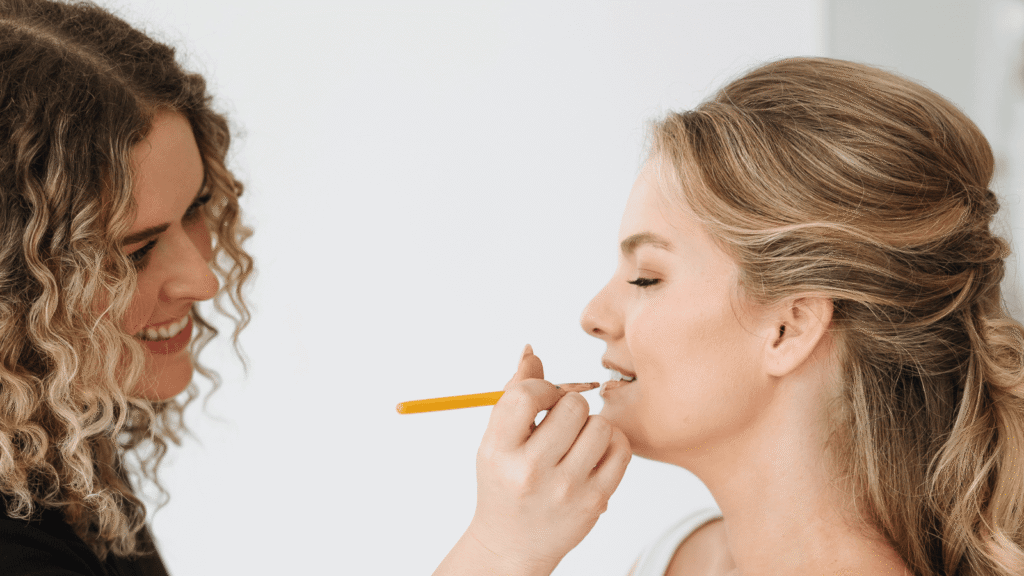
A contour that looks balanced in the mirror can look much stronger in a wedding photo. A shadow near the cheekbone may deepen under certain lighting, while a contour that seems barely visible during the getting-ready process can become more noticeable in close-up photos. That is why bridal contour needs a lighter touch than simply following a contouring trend or copying a placement chart.
Contouring for a wedding takes more than choosing where to place a darker shade. The amount, placement, and blending all affect how the face looks in person and on camera. At Brittany Brown Beauty, we consider the bride’s features, the overall makeup look, and the lighting when deciding how much definition to add.
The right amount of contour should work with the foundation, blush, bronzer, and eye makeup rather than compete with them. When the placement and blending are right, contour can add dimension without making the makeup look heavy up close.
Why Bridal Contour Is Different From Everyday Contour
Everyday contour is judged in a mirror, at a short distance, under one kind of light. Wedding makeup has to work in many more situations. Photographers shoot close-ups and wide shots. The light changes from the getting-ready room to the ceremony to the reception. Flash and natural light show makeup in different ways, and the camera angle shifts with every pose.
That is why heavy contour can look one way in person and another in photographs. Cameras can flatten the face, and some definition may read softer on camera than it does in the room. Stronger is not automatically better, though. Flash and close-up shots can make a heavy or poorly blended contour look harsh. Our article on why bridal makeup looks different in photos explains more about these factors.
Bridal makeup has to work both in person and in photographs. That calls for controlled blending and a result that still looks natural up close. No single contour technique suits every bride, so the approach depends on your features, your skin, and the setting.
Dos: What Works for Photos and In Person
These habits help natural bridal contour hold together in person and in wedding photos. They apply to wedding makeup contour of any intensity, from soft to more defined.
Do Match the Intensity to the Rest of the Makeup
Contour should make sense next to your foundation, blush, bronzer, eye makeup, and lip color. A soft, natural look usually calls for a lighter hand. A bolder eye or lip may support a bit more definition. Whatever the balance, the pieces should read as one look.
Do Build Gradually
Thin layers give the artist more control. It is often easier to add definition than to take it away, so building slowly leaves room to adjust intensity as the look comes together. This does not guarantee a particular result, but it makes adjustments easier. Skin condition matters too. Dry or textured areas may hold product differently than smooth areas, so preparation and formulas matter. Our guide to bridal makeup for different skin types covers how skin type can shape the application.
Do Blend Beyond the Initial Placement
Contour looks most natural when it fades softly into the surrounding complexion. Blending beyond the first placement softens the edges, so the contour reads as shadow instead of a line. The same goes for the areas around it, such as foundation and blush.
Do Consider Your Face Shape Without Following a Rigid Template
Face shape can influence where contour sits. There is no single contour map that every bride needs to follow, though. Your bone structure, your features, and the look you want all matter more than a template. A good artist adjusts placement to you.
Do Check the Makeup Under Different Lighting
Look at your makeup in the getting-ready environment, and where practical, under lighting that resembles your wedding setting. Window light, indoor light, and flash can each show contour differently. Photography is part of this check, which is one reason it belongs in the trial process.
Do Keep the Overall Look Balanced
Contour should support the rest of the makeup instead of becoming the main feature. If the eyes are the focus, contour can stay softer. Our article on bridal eye makeup styles shows how different eye looks change the balance of the whole face. It is also a good source of bridal makeup ideas.
Don’ts: Common Contouring Mistakes
These common mistakes can make contour look heavy, harsh, or out of place.
Don’t Copy a Contour Map Without Considering Your Features
Online diagrams are starting points, not universal instructions. They assume a certain face, and your features may not match. Copying one exactly can put contour where it does not suit you.
Don’t Use Too Much Product at Once
Too much product at once makes blending harder and makes contour more noticeable. A heavy first layer can be difficult to soften later. Start light and add only where the face needs it.
Don’t Leave Hard Lines
Hard edges can make contour look like makeup. In photographs, they may read as stripes. Soft transitions keep the result believable at close range.
Don’t Match Contour to Your Foundation Shade
Foundation and contour do different jobs. Foundation evens the complexion, while contour adds depth. Treating them as the same shade family can leave the result looking flat or muddy, depending on your skin and the formulas. Exact shade choices vary with complexion, undertone, and product, so it is better to test them than to follow a fixed rule.
Don’t Judge the Finished Look Only in One Mirror
One mirror shows one kind of light from one distance. Lighting, camera distance, and viewing angle can all change how contour appears. Step back, move to a window, and look at photos from the trial before you decide.
Don’t Chase a Completely Different Facial Shape
Contour cannot create a new face, and trying to do so can look unnatural. Our approach is enhance, don’t mask. The bride should still look like herself, with definition that supports her natural features. A few small, well-placed touches often do more than a dramatic change.
Testing Your Contour at the Trial
A bridal makeup trial is the best place to test contouring for bridal makeup. You and your artist can see the look in person, check how it photographs, and adjust it before the wedding. Topics worth talking through include:
- How much definition you prefer, from soft to more defined.
- Where the contour sits, and whether the placement feels natural on you.
- How the contour looks in person and in photographs.
- How it works with your foundation, blush, eyes, and lips.
- How it looks under different lighting.
- What you like and what you want changed.
A trial is also the place to see how the makeup wears and feels on your own skin over several hours. No one can promise how contour will last through an entire wedding day, so the trial is the best way to plan for it. If you have concerns about sensitivity, tell your artist before the trial.
Plan Your Bridal Makeup Trial
Your trial is the time to put these contouring dos and don’ts to work and to choose contour placement and intensity before the wedding. It gives your artist a chance to discuss your preferred level of definition, your overall makeup style, and how the look photographs. Brittany Brown Beauty provides mobile bridal hair and makeup in Orange County, San Diego, and surrounding areas. Click the button below to schedule a consultation online.
Frequently Asked Questions
Keep a consistent skincare routine well before the wedding, and avoid new skincare or makeup products during the final 10 days. Arrive with clean, comfortable skin. Tell your artist about any sensitivities so the products can be chosen with that in mind.
No specific number of hours can be promised. Wear depends on skin type, preparation, the formulas used, layering, setting, weather, and how active the day is. Wearing your look for several hours at a trial gives you a better idea of how it holds up on your skin.
Yes. Shade, formula, placement, and intensity can all be adjusted for the individual bride. The right choices depend on your complexion, your features, and the look you want. A trial lets you compare options on your own face.
It depends on your features, the lighting, and the camera distance. The aim is enough definition to add dimension while staying soft enough to look natural in person. The main contouring dos and don’ts for brides come down to blending, balance, and testing, and photos from your trial show whether the level feels right.
Yes. The trial lets you see how the contour looks in person and in photographs, and how it works with the rest of your makeup. It also gives you a chance to say what you like and what you would change.