
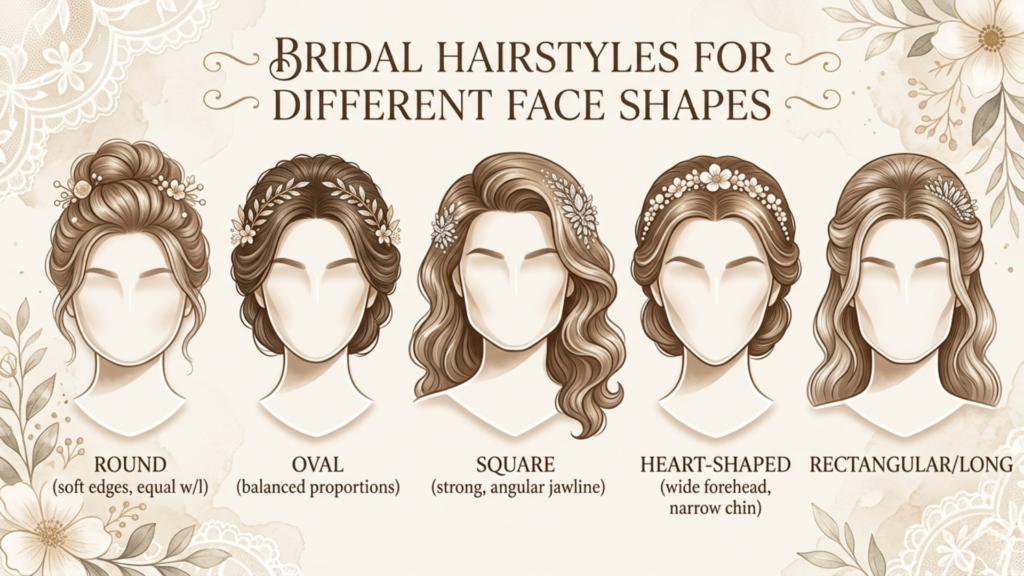
Many brides save hairstyles they love, then feel something looks “off” when they try it. The style itself isn’t the problem. The fit is.
Your face shape affects how volume, height, and framing show up in photos. The same hairstyle can look balanced on one person and heavy or flat on another.
This guide explains bridal hairstyles for different face shapes and, more importantly, why certain choices flatter your features. When you understand the “why,” it becomes much easier to choose a style that actually works for you.
Why Face Shape Matters More Than Trends
Trends come and go. Your face shape doesn’t.
Hair changes how your face is perceived. A bit of height at the crown can make your face look longer. Volume at the sides can make it look wider. Face-framing pieces can soften or sharpen your features.
The goal is not to fix your face. It is to create balance so your features look natural in both real life and photos.
That’s why copying a trending style without adjusting it often leads to disappointment.
How to Identify Your Face Shape (Simple Method)
You don’t need complicated measurements. You just need to observe a few key points.
Look at the width of your forehead, cheekbones, and jawline. Then compare your face length to its width.
- If your face is almost equal in width and length with soft edges, it’s likely round
- If your face is longer than it is wide with balanced proportions, it’s oval
- If your jawline looks strong and angular, it’s square
- If your forehead is wider and your chin is narrower, it’s heart-shaped
- If your face looks noticeably longer than it is wide, it’s long or rectangular
A simple tip is to look at photos of yourself instead of the mirror. Photos give a more accurate view of how others see your face.
Bridal Hairstyles for Round Face Shapes
Key Features
A round face has soft edges and similar width and length. It can appear fuller in photos if the hairstyle adds too much width.
What Works Best
Styles that add height at the crown help elongate the face. Soft waves that fall below the shoulders also create a longer visual line. Half-up styles with volume at the top can work well too.
What to Avoid
Flat hairstyles or tight curls that sit close to the sides can make the face look wider. Very symmetrical styles can also emphasize roundness.
Why These Styles Work
Height draws the eye upward, which visually lengthens the face. At the same time, controlled volume prevents the face from looking too wide.
Bridal Hairstyles for Oval Face Shapes
Key Features
Oval faces are naturally balanced. The length is slightly greater than the width, and the proportions are even.
What Works Best
Most hairstyles suit this face shape. You can wear hair up, down, or half-up without major issues.
What to Be Careful With
Too much height at the crown or very long, flat styles can stretch the face further.
Why Balance Still Matters
Even though oval faces are versatile, extreme styles can still throw off proportions. Keeping the look balanced ensures everything stays harmonious.
Bridal Hairstyles for Square Face Shapes
Key Features
Square faces have strong jawlines and defined angles.
What Works Best
Soft waves, loose curls, and textured updos help soften the structure. Face-framing pieces also reduce the sharpness around the jaw.
What to Avoid
Tight, slicked-back styles or very straight lines can make the face look more angular.
Why Softness Matters
Texture breaks up strong lines. When the hair moves naturally, it softens the overall look and creates a more balanced appearance.
Bridal Hairstyles for Heart-Shaped Faces
Key Features
Heart-shaped faces are wider at the forehead and narrower at the chin.
What Works Best
Styles that add volume near the jawline help balance the face. Side-parted styles and soft half-up looks work well.
What to Avoid
Too much height at the crown can make the forehead look wider.
Balance Strategy
By adding volume lower down, you even out the proportions between the top and bottom of your face.
Bridal Hairstyles for Long or Rectangular Face Shapes
Key Features
Long faces have more length than width, often with straight sides.
What Works Best
Volume at the sides helps create width. Waves, curls, and low buns can shorten the appearance of the face.
What to Avoid
Too much height at the crown or very flat, straight styles can make the face look longer.
Why Width Matters
Adding width balances the length, which creates a more proportioned look in photos.
Face Shape vs Hair Type: Why Both Matter
Face shape gives direction, but hair type decides what’s possible.
For example, a round face may benefit from volume at the crown. However, if your hair is very fine, that volume needs to be built carefully so it holds.
Thick hair can support structured styles more easily, but it may need control to avoid looking too heavy.
Curly hair adds natural volume, which can work well for some face shapes but may need shaping to avoid imbalance.
So, the final hairstyle should match both your face shape and your natural hair behavior.
How Your Dress and Veil Change the Look
Your hairstyle does not exist on its own. It works as part of your full bridal look.
A high neckline pairs better with updos because it keeps the top area clean. A strapless dress allows more flexibility with hair down or soft waves.
Veil placement also changes proportions. A veil placed higher can add height, while a lower placement keeps the look more grounded.
When everything works together, your overall look feels more intentional.
What to Test During Your Bridal Hair Trial
Your trial is where everything comes together.
Try styles that follow your face shape guidelines, then take photos from the front and side. These angles show how balanced the hairstyle looks.
Pay attention to how volume sits. Too much height or width can shift the balance.
Also, check how the style holds after some time. Movement and wear can change how it looks.
Use the trial to refine, not just choose.
Common Mistakes Brides Make
One common mistake is copying a hairstyle without adjusting it to suit their face. Even a small change in volume or parting can make a big difference.
Another mistake is choosing trends over balance. A trending style may not work for your proportions.
Some brides also ignore how hairstyles look in photos. What looks good in person can feel different on camera.
Overdoing volume or flattening the hair too much can also throw off the overall look.
Find a Bridal Hairstyle That Flatters Your Face Shape
Choosing the right hairstyle can feel overwhelming when you’re looking at too many options.
At Brittany Brown Beauty, we help brides choose styles that suit their face shape, hair type, and overall bridal look. During your trial, we adjust the style based on what truly works for you, not just what looks good in photos.
You can also view our portfolio to see real bridal looks we’ve created.
Book your bridal hair consultation to find a look that feels balanced, comfortable, and right for your wedding day.
Frequently Asked Questions
Look at your proportions in photos and compare your forehead, cheekbones, jawline, and face length.
The most flattering style is one that balances your face shape and works with your hair type.
Yes, but it should be adjusted to suit your features so it looks balanced.
Yes, but the structure, volume, and placement need to be adjusted for each face shape.
Yes. A center or side part can change how balanced your face appears, especially in photos.